How love calculators turn two names into a percentage
Updated October 12, 2026 · 7 sections
Type the same two names into three love calculators and you can walk away with three different percentages. Nothing is broken. They are different machines under the same pink heart, and once you know which kind you are looking at, you can tell what the number does and does not mean.
I sort every name-based love calculator into one of three families. The sorting question is simple: could you reproduce the number with a pencil? If yes, it is a game with rules. If no, it is a black box, and the only honest move is to treat the number as decoration. The name compatibility calculator on this site sticks to the first and third family and shows its working, for exactly that reason.
Three kinds of love calculator
| Family | What it does with the names | Reproducible on paper? |
|---|---|---|
| Letter-count games | Counts specific letters (the classic is the l, o, v, e, s count) and runs a number routine on the counts | Yes, every row |
| Hidden formulas | Adds letter positions, takes a remainder, mixes in name length, or draws a random number | No, unless the site publishes the formula |
| Numerology charts | Turns each name into a single digit and looks the pair up in a compatibility chart | Yes, if the chart and letter table are published |
The LOVES game, one row at a time
The playground classic works like this. Put both names together and count how many times each of the letters l, o, v, e and s occurs. Write the five counts in that order. Then add each pair of neighbouring digits, write the sums as a new row, and repeat until fewer than three digits remain. That final number is the percentage.
Take Alice and Bob. ALICE has one L and one E, BOB has one O, and neither name has a V or an S. The five counts are 1, 1, 0, 1, 0, so the first row reads 11010.
- 11010 gives 1+1, 1+0, 0+1 and 1+0, which is 2, 1, 1, 1.
- 2111 gives 2+1, 1+1 and 1+1, which is 3, 2, 2.
- 322 gives 3+2 and 2+2, which is 5 and 4.
- Two digits remain, so the answer is 54%.
The word "loves" itself is not counted, only its five letters. This is the form of the game that researchers at the University of Birmingham describe in their news piece on endless love, and Alice and Bob are the example they use.
What happens when a sum has two digits
This is the step most people get wrong. When two neighbours add up to 10 or more, you write both digits of the sum, not one two-digit block. Olivia and Noah show it. Between them they have 1 L, 2 O, 1 V and no E or S, so the first row is 12100.
| Row | Digits | How it was made |
|---|---|---|
| 1 | 12100 | Counts of l, o, v, e, s |
| 2 | 3310 | 1+2, 2+1, 1+0, 0+0 |
| 3 | 641 | 3+3, 3+1, 1+0 |
| 4 | 105 | 6+4 = 10, written as 1 and 0; then 4+1 = 5 |
| 5 | 15 | 1+0, 0+5; two digits, so stop |
The result is 15%. Writing 10 as a single block would shorten the row and end the game early on a different answer. The splitting convention is spelled out in Johnston's paper Endless love, and it is the one I follow.
Endless love: the games that never finish
Some pairs never settle. Oliver and Lovell have 4 L, 2 O, 2 V and 2 E between them (counting each letter in both names) and no S, so the first row is 42220. The rows then run 6442, 1086, 1814, 995 and back to 1814. A row that has already appeared means every later step repeats the same loop. A calculator that does not notice this will freeze or print an arbitrary number. Mine stops at the repeat and says "endless love".
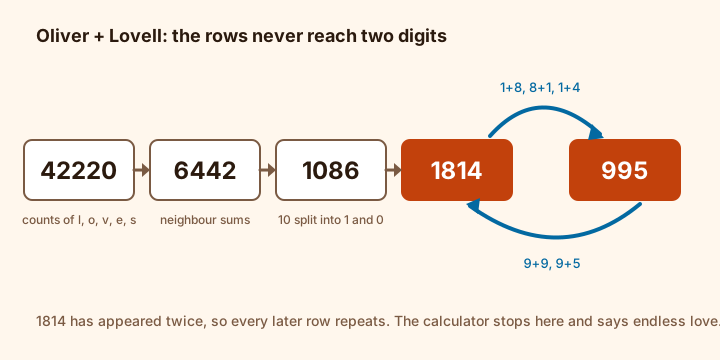
The study behind the game found that endless loops are a real property of it, not a curiosity. Among the 50 most common UK first names, no pair loops. Adding surnames makes looping more likely. Names holding between 2 and 6 of the letters l, o, v, e, s tend to score best, while names with none of them have a low expected score of about 26% in the researchers' sample. Stopping at a repeated row or at a row longer than 40 digits gave the same verdicts as allowing 200 digits on every pair I compared.
Why two sites give different numbers for the same names
Hidden formulas are where most of the disagreement comes from. Here are two made-up formulas, invented only to show the principle, run on Alice and Bob.
| Formula | Working | Percentage |
|---|---|---|
| A: add letter positions, keep the last two digits | ALICE = 30, BOB = 19, total 49 | 49% |
| B: total letters times 7, plus the vowels | 8 letters x 7 = 56, plus 4 vowels | 60% |
| LOVES game | 11010, 2111, 322, 54 | 54% |
Three methods, three numbers, and none is wrong because none claims to measure anything. More differences come from how names are cleaned before counting. A site that counts the hyphen in Mary-Jane gets a different length from one that ignores it. A site that deletes accented letters turns José into JOS. Some calculators draw a random number on every click, so the same pair gives a new answer when you reload.
Four quick tests for any calculator: type the same names twice, swap the two names, add or remove a space, and type an accented letter. A trustworthy tool gives identical results for the first three and tells you what it counted for the fourth.
Numerology charts: symbolic by design
The third family reduces each name to a single digit using a letter table, then looks up the pair in a chart. Alice adds up to 21 in the Pythagorean system, which reduces to 3. Bob adds up to 10, which reduces to 1. On the grid used here, 3 and 1 are a traditional pairing, so the reading is "complementary". Numbers from the same family read "natural", and numbers from different families that are not traditional partners, such as 1 with 2, read "challenging".
Be clear about what that means. A published numerology compatibility chart describes its ratings as not measured probabilities of relationship success, and numerology as a whole is a belief system that Wikipedia classes as pseudoscience. I enjoy it as a tradition and as a way to compare two names, and I would not use it for anything else.
A score is not a verdict
None of these three families looks at the two people. They look at spelling. Change one letter and the number moves; I show how far in the guide on which name to type. Treat a low score as a laugh and a high score as a nice excuse to send a message, and keep the decisions that matter well away from both.
That is also why the calculator here has no random element and no hidden adjustment. The same names always give the same rows, swapping the names changes nothing, and the full working is on screen for you to check. For the paper version of the other classic game, read how to play FLAMES.
FAQ
How do love calculators work?
They follow one of three methods: a letter-count game such as LOVES, a hidden formula based on letter sums or randomness, or a numerology chart that reduces each name to a digit. Only the first and third can be repeated by hand.
How is the love percentage calculated from names?
In the LOVES game you count the letters l, o, v, e and s in both names, add neighbouring digits row by row, and stop when fewer than three digits are left. Alice and Bob give 11010, 2111, 322 and 54%.
Why do different love calculators give different results?
They use different formulas, clean the names differently (hyphens, spaces, accents) or add a random element. The same two names can therefore produce several percentages.
Are name compatibility tests accurate?
They are accurate at what they calculate, which is a result from spelling, and they cannot measure a real relationship. Treat the score as entertainment.