How to play FLAMES: rules, both variants and what each letter means
Updated October 12, 2026 · 8 sections
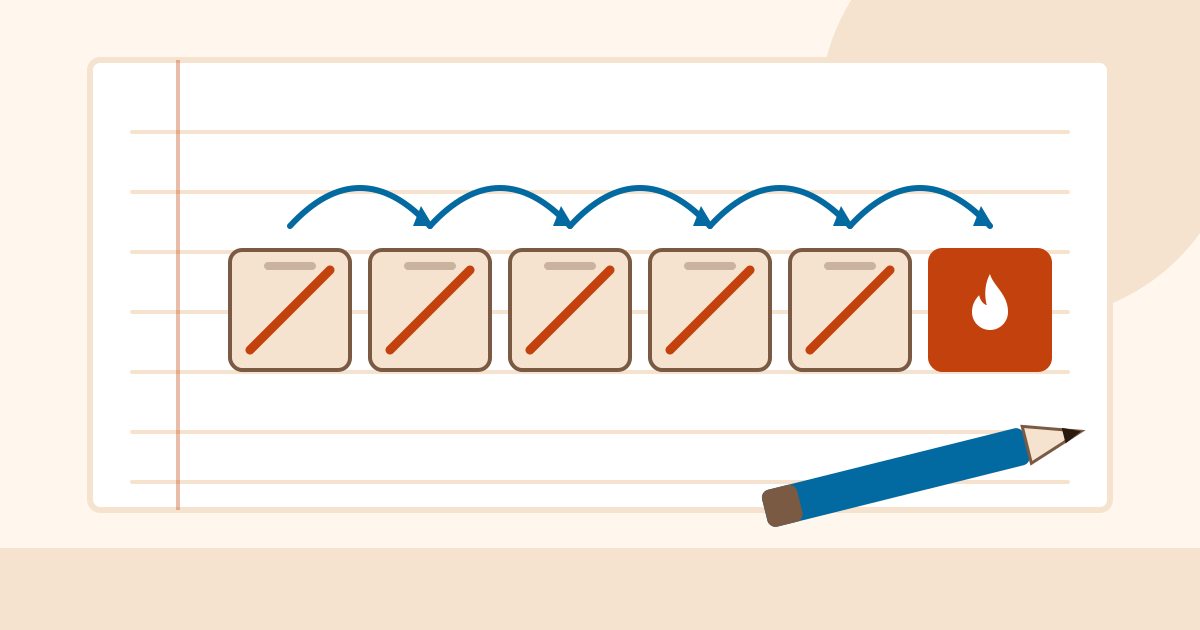
Two names, one pencil and about a minute: that is all FLAMES needs. Nearly every argument over a result starts in one of two places, which letters get crossed out and where each new count begins, and both can be settled before anyone picks up the pencil.
I have played FLAMES on kitchen tables, bus seats and group chats, and the game never changes. Strike the letters the two names share, count what is left, then use that number to knock letters out of the word FLAMES until one survives. The survivor is your answer. Below you get the full method, both ways of striking shared letters, the counting slip that ruins most games, and a lookup table that lets you skip the ring entirely. If you would rather watch every strike happen, the name compatibility calculator animates the whole thing.
What the six letters stand for
| Letter | Usual reading | Other wording you will meet |
|---|---|---|
| F | Friends | Friendship |
| L | Love | Lovers |
| A | Affection | Affectionate |
| M | Marriage | Married |
| E | Enemies | Rivals, if you want to be kind |
| S | Siblings | Sister |
Some groups drop the S and play with FLAME, five letters instead of six. That is a different game, not a shorthand: with 5 letters left after the shared ones are struck, the six-letter ring ends on F while the five-letter ring ends on L. Say which one you are playing before the first name is written. The rules and their variants are collected in the Wikipedia article on FLAMES.
The paper method in seven steps
- Write the two names side by side. Only letters count, so ignore spaces, hyphens and apostrophes, and treat capitals and small letters as the same.
- Strike the letters the names share, using the rule you agreed on (next section).
- Count the letters still standing in both names together. Call that number n.
- Write FLAMES on a line, or in a circle if you like drama.
- Start on F and count n letters, wrapping from S back to F as often as needed. Cross out the letter where the count ends.
- Begin the next count on the first surviving letter after the one you just crossed out. Count n again and cross out that letter.
- Repeat until a single letter is left. That letter is the result.
Worked example: ROHAN and LENNA
ROHAN has one N, LENNA has two, and both have an A. Strike one A and one N from each name and what stays is ROH and LEN, so n = 3 + 3 = 6. Now play the ring: the count of 6 from F lands on S, and the elimination runs S, F, A, L, E. Only M survives, so this pair gets Marriage.
| Round | Letters in the ring | Count of 6 starts on | Crossed out |
|---|---|---|---|
| 1 | F L A M E S | F | S |
| 2 | F L A M E | F | F |
| 3 | L A M E | L | A |
| 4 | L M E | M | L |
| 5 | M E | M | E |
Notice round 3. Four letters are left and the count is 6, so it wraps past the end of the ring: L, A, M, E, then L and A again. Wrapping is where hand-played games go wrong, and it is why I count out loud with a finger on the page.
One-for-one or every copy?
This is the rule that splits the playground. Wikipedia notes that the cancelling of shared letters depends on the variant of play, and both versions are common.
- One-for-one. Each letter in the first name cancels at most one matching letter in the second. ROHAN and LENNA share A and N, but LENNA has a second N with nothing left to pair with, so that N stays. Result: ROH + LEN, n = 6, M.
- Every copy. Any letter that appears in both names is wiped from both entirely. A and N vanish everywhere, leaving ROH + LE, so n = 5. The ring order is E, M, S, L, A and the survivor is F.
| Rule | Letters left | n | Result |
|---|---|---|---|
| One-for-one | R O H + L E N | 6 | M, Marriage |
| Every copy | R O H + L E | 5 | F, Friends |
I play one-for-one by default. It treats each letter as a physical tile you can point at, so nobody has to remember an exception, and it keeps more letters in play. Every copy is quicker on paper, which is why it is popular for rushed games. Neither is wrong; mixing them inside one group is. The calculator uses one-for-one and has a switch for the other.
A rarer shortcut counts n once around FLAMES and takes the letter where you land, with no eliminations. For ROHAN + LENNA that is S. It is much simpler and it also ignores most of what makes FLAMES fun, so check which version your friends mean before you quote a result.
The counting slip that wrecks the most games
After each strike, the next count starts on the first surviving letter after the struck one. It does not restart at F, and it does not begin on the letter you just crossed out. Restarting at the front feels natural because round 1 and round 2 both start at F, so the error hides until round 4.
| How you count | Crossed out in order | Result |
|---|---|---|
| Correct: continue after the struck letter | S, F, A, L, E | M, Marriage |
| Slip: restart at the first letter every time | S, F, A, E, M | L, Love |
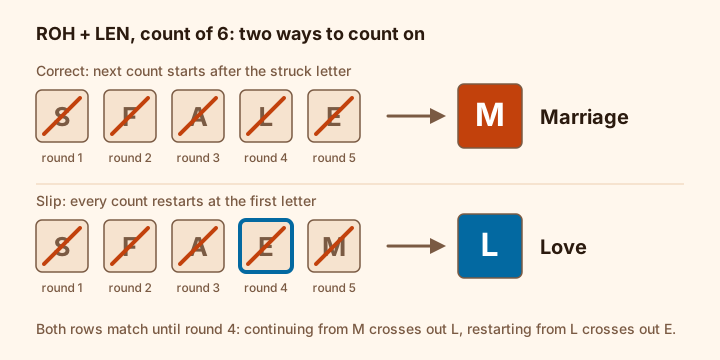
Same names, same count, a different verdict. Three smaller slips follow it in frequency: counting a hyphen or space as a letter (Mary-Jane is the eight letters MARYJANE), forgetting a doubled letter such as the second N in LENNA, and counting the letter you are standing on as zero instead of one.
Skip the ring: the count decides everything
The ring only ever sees the number n. Crossing out every n-th letter of a circle until one is left is a classic puzzle called the Josephus problem, and for the six letters of FLAMES the answer repeats every 60 counts. So you can work out n once and read the result off a table.
| n | 1 | 2 | 3 | 4 | 5 | 6 | 7 | 8 | 9 | 10 |
|---|---|---|---|---|---|---|---|---|---|---|
| Result | S | E | F | E | F | M | E | A | E | L |
| n | 11 | 12 | 13 | 14 | 15 | 16 | 17 | 18 | 19 | 20 |
|---|---|---|---|---|---|---|---|---|---|---|
| Result | M | A | A | F | M | F | A | F | L | E |
Across the counts 1 to 40, F comes up 9 times, E 8, A 7, M 6, and S and L 5 each. Love is the rare one: it only appears for the counts 10, 19, 36, 37 and 39. If you get one of those, you have earned the teasing.
When no letters are left
Anna and Anna, or Anna and Nana, cancel completely under either rule. With n = 0 there is nothing to count and FLAMES simply cannot be played. Add a middle name or a surname to one or both sides and play again. Do not invent a result for the empty case; that is how friendly games turn into arguments.
Playing it with a group
- Settle three things aloud before any pencil moves: one-for-one or every copy, six letters or five, and which names you are using (see which name to type).
- Have two people count each pair separately. If the two n values differ, recount together; one of you skipped a doubled letter.
- Use the lookup table for the quick answer and the ring only for the audience.
- For a crush list, write one name down the left side, then n and the letter beside each candidate. Twelve names fit on a page, and the calculator has a list mode that does the same.
- Read Enemies as rivals who keep each other sharp. Nobody should leave the table feeling sentenced.
If you want to see how percentage-style name games are built, read how love calculators turn two names into a percentage.
FAQ
What does FLAMES stand for?
Friends, Love (or Lovers), Affection, Marriage, Enemies and Siblings (or Sister). Some groups drop the S and play with FLAME.
Do you cross out all the common letters or just one each in FLAMES?
Both rules exist. One-for-one cancels a single copy in each name per shared letter; every copy removes a shared letter everywhere. ROHAN + LENNA gives M one way and F the other, so agree on the rule first.
What does E mean in FLAMES?
E is Enemies. Play it lightly: rivals who push each other, not a warning about a real person.
What if two names leave no letters at all?
Then n is 0 and FLAMES cannot be played. Add a middle name or surname to one side and count again.
Where does the next count start after a letter is crossed out?
On the first surviving letter after the crossed one, not back at F. Restarting at F is the most common slip and can change the result.