Name Compatibility Calculator: FLAMES, Love Score and Name Numbers
Type two names and the name compatibility calculator plays FLAMES, the LOVES love percentage and Pythagorean or Chaldean name numbers, showing every crossed-out letter and every sum.
Name compatibility calculator
Type two names and press the button: you get FLAMES, the LOVES score and both name numbers, every step shown.
These are name games and a numerology tradition, not a measure of a real relationship: nothing here should decide who you date or stay with.
FLAMES, step by step
LOVES pyramid
Count the letters L, O, V, E and S in both names, then keep adding neighbouring digits; a two-digit sum is written as two digits. The game stops at two digits.
Name numbers in both systems
| # | Name | LOVES | FLAMES | Numbers |
|---|
These are name games and a numerology tradition, not a measure of a real relationship: nothing here should decide who you date or stay with.
Recent games (last 5)
No games yet.
Saved only in this browser on this device.
Three name games, one name compatibility calculator
I have run these games at sleepovers, in classrooms and in group chats, and every group has its own house rules. So the name compatibility calculator above invents no secret score: it plays the three games people actually mean and shows the working for each:
- FLAMES: cross out the shared letters, count what is left around F-L-A-M-E-S, and land on Friends, Love, Affection, Marriage, Enemies or Siblings.
- LOVES love score: count the letters l, o, v, e and s in both names and add neighbouring digits until a percentage is left.
- Name numbers: turn each name into a number with the Pythagorean or the Chaldean letter chart and look the pair up on a symmetric match chart.
These are name games and a numerology tradition, not a measure of a real relationship. Nothing here should decide who you date or stay with. Numerology is a belief system that science classes as pseudoscience; I treat it as a tradition worth knowing, not a forecast.
Getting a result in under a minute
- Type both names the way you want them counted: first names for a quick game, full names for a longer one. Accents are fine (José, Zoë, Jürgen); the tool shows the spelling it counted, for example “Counted as: JOSE + MARIA”.
- Pick the FLAMES rule your group uses: one-for-one crossing out (the default) or crossing out every copy of a shared letter.
- Pick the letter chart for name numbers: Pythagorean or Chaldean.
- Watch the board: shared letters are struck through pair by pair, F-L-A-M-E-S drops out letter by letter at about a third of a second per step, and the LOVES rows build down to the score. Press Replay to watch again or Show all steps to see everything at once; if your device is set to reduce motion, the whole board appears at once.
- Have a crush list? Switch to the crush list, put one name against up to 12 others (one per line) and get them ranked by love score, endless love first, with the FLAMES letter and the match level beside each name. Tap a name to open the full pair, or copy the ranking as text for the chat.
Everything runs in your browser: names are never sent anywhere, and the history of your last five games stays in this browser on this device until you press Clear history.
FLAMES by hand: the ROHAN and LENNA example
I teach the FLAMES game with one example anyone can check. Write ROHAN and LENNA. A and N appear in both, so cross out one A and one N in each name. What remains is ROH + LEN: 6 letters.
Now write F L A M E S in a circle and count 6 from F. You land on S, so cross it out. The next count starts on the letter after the one you just crossed out, which is F. Six more lands on F; then A, then L, then E. M is the only letter left, so ROHAN and LENNA get Marriage.
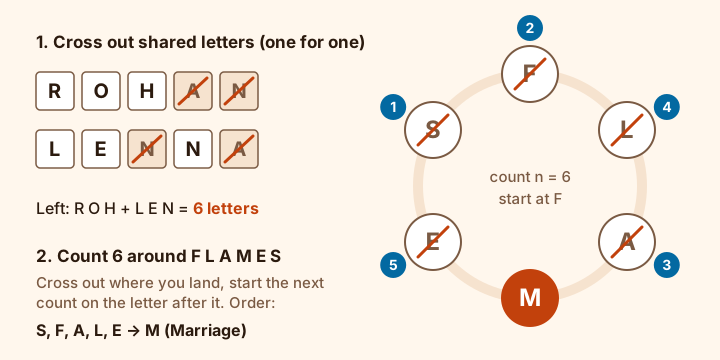
Here is where groups argue. Some people cross out every copy of a shared letter. LENNA has two Ns, so both go, and the count drops to 5: ROH + LE. Five around the circle leaves F for Friends. Same names, two answers, and both are legitimate house rules. Agree on the rule before you start; the toggle in the tool shows the other answer.
The most common slip I see on paper is restarting each count at F. Always restart on the letter after the one you crossed out, or every result shifts.
Every FLAMES result from 1 to 20 letters
Because the crossing-out depends only on how many letters are left, the result is fixed for each count. Once you know your count, you can read the answer straight off this table (the pattern repeats every 60 letters):
| Letters left | Result | Letters left | Result |
|---|---|---|---|
| 1 | S Siblings | 11 | M Marriage |
| 2 | E Enemies | 12 | A Affection |
| 3 | F Friends | 13 | A Affection |
| 4 | E Enemies | 14 | F Friends |
| 5 | F Friends | 15 | M Marriage |
| 6 | M Marriage | 16 | F Friends |
| 7 | E Enemies | 17 | A Affection |
| 8 | A Affection | 18 | F Friends |
| 9 | E Enemies | 19 | L Love |
| 10 | L Love | 20 | E Enemies |
Love is the rarest outcome: between 1 and 40 letters it only comes from counts of 10, 19, 36, 37 and 39. If the two names share every letter (Anna and Anna), nothing is left to count; add a surname or middle name.
How the love percentage is calculated
The love percentage comes from the playground LOVES game, which mathematicians at the University of Birmingham took apart in detail. Count how many of each letter l, o, v, e and s appear in the two names together and write the five counts in a row. Then add each pair of neighbours to make a shorter row, and keep going until fewer than three digits remain.
Alice and Bob: one L, one O, no V, one E, no S gives 11010. Adding neighbours: 1+1, 1+0, 0+1, 1+0 = 2111. Then 322, then 54. Love score: 54%.
The rule people miss is the split: a two-digit sum is written as two digits. Olivia and Noah give 12100 → 3310 → 641. Now 6 + 4 = 10 is written as 1 and 0, and 4 + 1 = 5, so the next row is 105, not 10 5. Then 1+0 and 0+5 give 15%.
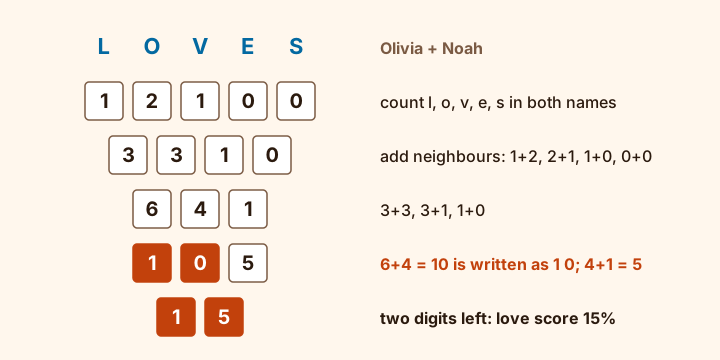
The same study found that names with two to six of these letters tend to score best, while names with none average about 26%. A low score is just arithmetic on letters.
When the game never ends: endless love
Some pairs never get down to two digits. Oliver and Lovell give 42220 → 6442 → 1086 → 1814 → 995 → 1814, and 1814 comes back forever. The calculator spots a repeated row (or a row that grows past 40 digits) and calls the result endless love, showing where the loop closes. According to the original paper on the game, no pair among the 50 most common UK first names loops, but adding surnames makes a loop more likely.
Name numbers and the match chart
For name numbers, each letter gets a value and the values are added. In the Pythagorean chart, A to I are 1 to 9, then J starts again at 1. Alice is A1 L3 I9 C3 E5 = 21, and 2 + 1 = 3. Bob is B2 O6 B2 = 10, reduced to 1. Totals of 11, 22 and 33 are kept as master numbers: Rohan adds up to 29 and the tool shows “29 → 11 (master number)”. Every letter value is listed under each name, so you can follow the sum.
The Chaldean chart is uneven: no letter is worth 9, and the “Chaldean name number” is shown as a compound number with its single digit, or just the digit when the total is 9 or less. Alice is A1 L3 I1 C3 E5 = 13/4; Bob is B2 O7 B2 = 11/2; María is 9. The letter tables I follow also explain the usual advice: the Pythagorean count uses the full birth name, the Chaldean count the name you go by every day.
The pair is then read on one symmetric 9×9 chart built on three families: 1-5-7, 2-4-8 and 3-6-9. Same family is a natural match, some cross-family pairs are traditionally complementary, and the rest are challenging, which only means a different pace. Master numbers use their base digit (11 → 2, 22 → 4, 33 → 6). The pair is highlighted on a small chart, and the Pythagorean chart is the default with Chaldean one tap away. Alice (3) and Bob (1) come out complementary on the Pythagorean chart and natural on the Chaldean one (4 and 2). As one compatibility chart puts it, these ratings are symbolic, not measured probabilities.
Accented names count in full
Many name tools quietly delete letters they do not recognise. Type José and they count JOS: Chaldean 11, reduced to 2. Counted properly as JOSE it is 16, reduced to 7. Here the box keeps any letter you type, and the name is folded for counting: é → e, ü → u, ß → ss, æ → ae, œ → oe, ø → o, ł → l, þ → th. The tool tells you what it counted, for example JOSE + MARIA, so Straße and Œdipe become STRASSE + OEDIPE. A name in another alphabet, such as Cyrillic, needs a Latin spelling first; the tool says “Type a Latin spelling of the name” rather than failing silently.
Where every number comes from
The name compatibility calculator applies each rule above exactly as written: only the letters a to z count after folding (spaces, hyphens and apostrophes are ignored), FLAMES uses one-for-one crossing out unless you switch it, the love score splits two-digit sums, and the same two names always give the same result. There is no hidden formula and no random reading: the sentence under the score depends only on the score band and the FLAMES letter. The headline is the love score, with the FLAMES letter and the match level beside it, and no other invented overall score. The tool is tested against pairs I worked out independently, by hand and in code:
| Names | FLAMES | Love score | Name numbers | Match |
|---|---|---|---|---|
| Alice & Bob | 8 → A | 11010 → 54% | 3 & 1 | complementary |
| Rohan & Lenna | 6 → M (every copy: 5 → F) | 11010 → 54% | 11 & 1 | challenging |
| Olivia & Noah | 6 → M | 12100 → 15% | 5 & 2 | challenging |
| José & María | 9 → E | 01011 → 45% | 4 & 6 | complementary |
| Jürgen & Renée | 5 → F (every copy: 3 → F) | 00040 → 53% | 3 & 11 | challenging |
| Mary-Jane & Peter | 9 → E (every copy: 8 → A) | 00030 → 39% | 33 & 1 | challenging |
| Oliver & Lovell | 4 → E | 42220 → endless love | 9 & 6 | natural |
| Anna & Anna | 0 → no letter | 00000 → 0% | 3 & 3 | natural |
Swapping the two names never changes a result, and the chart reads the same in both directions. On the Chaldean chart Jürgen & Renée (4 & 4) turn natural. The crush list is checked the same way: Oliver against Bob, Lovell, Zoë, Peter, Noah and Alice ranks Lovell first (endless love), then Zoë 65%, Bob 29%, Noah 29%, Peter 25% and Alice 22%, with ties kept in the order you typed them.
Go deeper
- How to play FLAMES: the paper method, both crossing-out rules and what each letter means.
- How love calculators turn two names into a percentage, and why two sites rarely agree.
- Full name, first name or nickname: which version to type for each game.
Guides
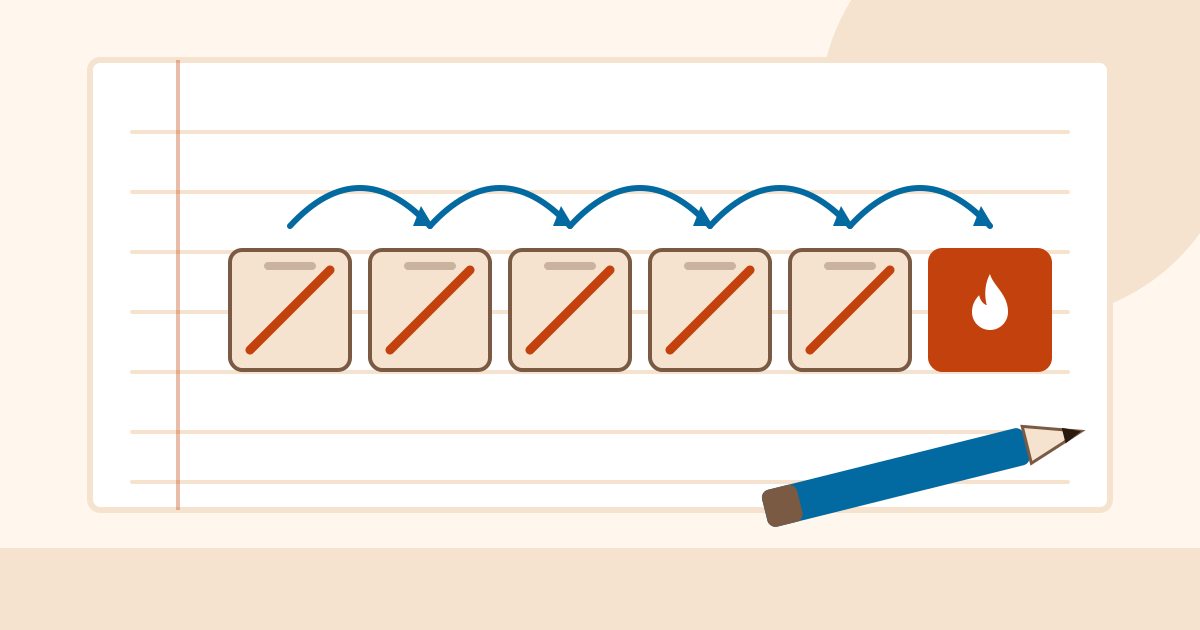 How to play FLAMES: rules, both variants and what each letter meansThe paper method for FLAMES, the one-for-one versus every-copy split, the counting slip that changes results, and a lookup table for counts 1 to 20.
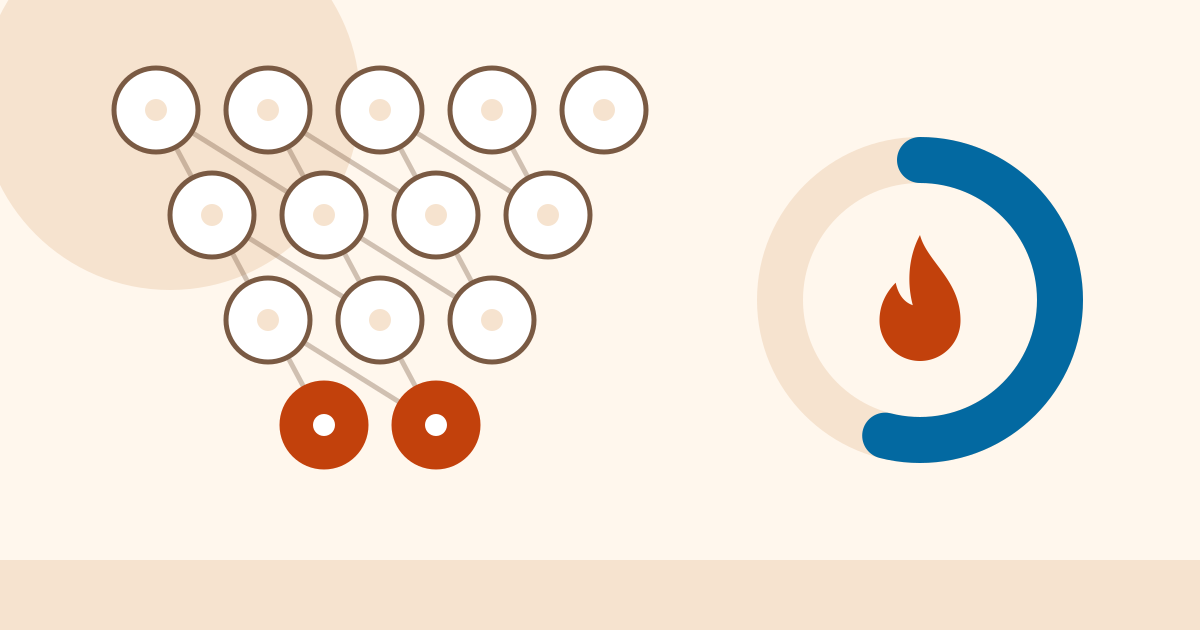 How love calculators turn two names into a percentageLetter-count games, hidden formulas and numerology charts compared, with the LOVES rows worked by hand and a note on endless loops.
 Full name or nickname for a name compatibility test?Daniel against four spellings of Elizabeth gives four answers. See which name each method reads and how surnames and accents move the result.
FAQ
Do you cross out all the common letters or just one of each in FLAMES?
Both rules are played. One-for-one (one A in each name cancels one A) is the default here; the other rule removes every copy of a shared letter. ROHAN and LENNA give Marriage one way and Friends the other, so agree on the rule first.
What does E mean in FLAMES?
E is Enemies, which in practice means rivals who keep each other sharp. It is a playground game, so treat it as a joke, not a warning.
Are name compatibility tests accurate?
No game based on letters can measure a relationship. The calculator is accurate in the narrow sense that it applies the rules of FLAMES, LOVES and numerology exactly and repeatably, but the results are for fun.
Should I use my full name or my first name?
Use the same kind of name for both people. First names give the classic quick game; full names change every result and make an endless-love loop more likely. For numerology, the Pythagorean tradition uses the birth name and the Chaldean the everyday name.
Why do different love calculators give different results?
Many sites run a hidden formula of their own, and the games themselves have house rules, such as how shared letters are crossed out or whether two-digit sums are split. Here every step is shown, so you can check it on paper.
Does it work with accents and other alphabets?
Yes for accented Latin letters: José is counted as JOSE, Jürgen as JURGEN, and ß, æ and œ expand to ss, ae and oe. A name in Cyrillic, Greek or another script needs a Latin spelling first, and the tool tells you so instead of guessing.
What if two names have all the same letters?
With identical names or anagrams, nothing is left after crossing out, so FLAMES cannot be played. Add a surname or middle name to one or both people.
Updated · About this site